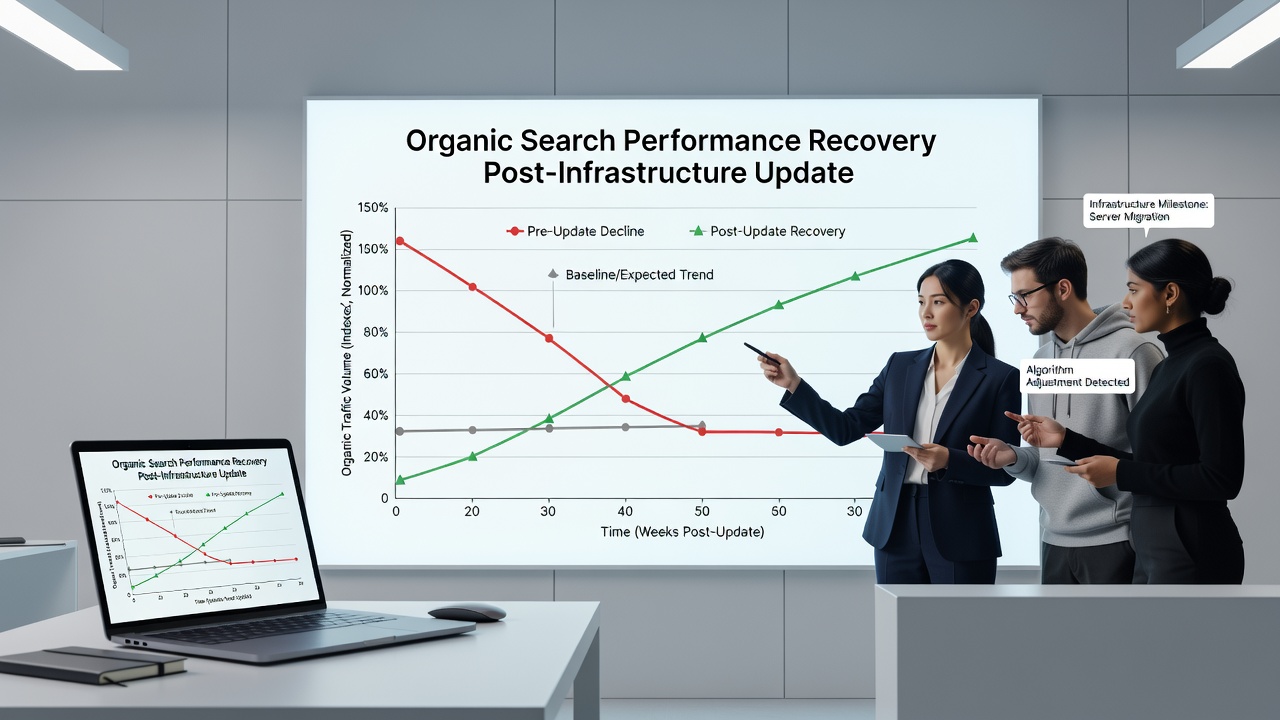
Wendy Hoffmann · 18 September 2026
Analyzing Recovery Patterns in Organic Search Performance After Infrastructure Updates
Organic search performance often experiences noticeable dips after infrastructure updates that involve server migrations, domain name system reconfigurations, content management system transitions, or hosting provider changes, and recovery patterns emerge through systematic monitoring of crawl data, indexation rates, and ranking positions across weeks or months. Researchers track these shifts by comparing pre-update baselines with post-update metrics from tools such as Google Search Console, which records impressions, clicks, and average positions while revealing how quickly search engines reprocess altered site structures.
Common Types of Infrastructure Updates That Affect Search Visibility
Server migrations frequently trigger temporary reductions in crawl frequency because search engine bots must rediscover new IP addresses and verify site integrity before resuming normal indexing schedules, whereas content management system changes can alter URL structures, metadata generation, or sitemap formats that delay reindexation until proper redirects and canonical tags take effect. DNS modifications sometimes create propagation delays that last from hours to several days, and during this window bots may encounter inconsistent responses that slow the overall recovery process. Data from multiple industry reports indicates that sites undergoing combined updates, such as simultaneous hosting and platform shifts, require longer stabilization periods than isolated changes because multiple technical signals must align before full ranking restoration occurs.
Those who monitor large-scale site transitions note that September 2026 brought renewed attention to these patterns after several major platforms released updated documentation on handling infrastructure events, and analysts observed that sites with pre-existing strong backlink profiles tended to regain visibility faster once technical issues resolved.
Observed Recovery Timelines and Traffic Fluctuation Patterns
Recovery timelines typically follow a phased structure where initial drops in organic traffic appear within 24 to 72 hours of an update, followed by partial rebounds between days 7 and 21 as core pages regain indexation, and more complete stabilization often emerging between weeks 4 and 12 depending on site size and update complexity. Figures from ongoing analyses show that smaller sites with fewer than 1,000 pages frequently recover 80 percent of prior traffic levels within six weeks, while enterprise properties with dynamic content generation may require three to six months before metrics return to pre-update ranges. Search engines adjust crawl budgets gradually after detecting consistent server responses, and this adjustment process explains why some sites experience secondary ranking fluctuations even after primary recovery appears complete.
Factors That Influence the Speed of Ranking Restoration
Pre-update preparation plays a central role because sites that implement comprehensive redirect maps, maintain consistent XML sitemaps, and preserve historical performance data through server logs tend to experience shorter disruption periods compared with those that address these elements reactively. Backlink quality and quantity also contribute since external signals help search engines confirm site legitimacy during re-crawling phases, and research indicates that domains with diverse referring sources regain position stability more rapidly. Technical elements such as proper robots.txt configurations, correct HTTP status codes, and mobile-first rendering compliance further accelerate recovery when they remain intact or receive prompt correction after the infrastructure event.
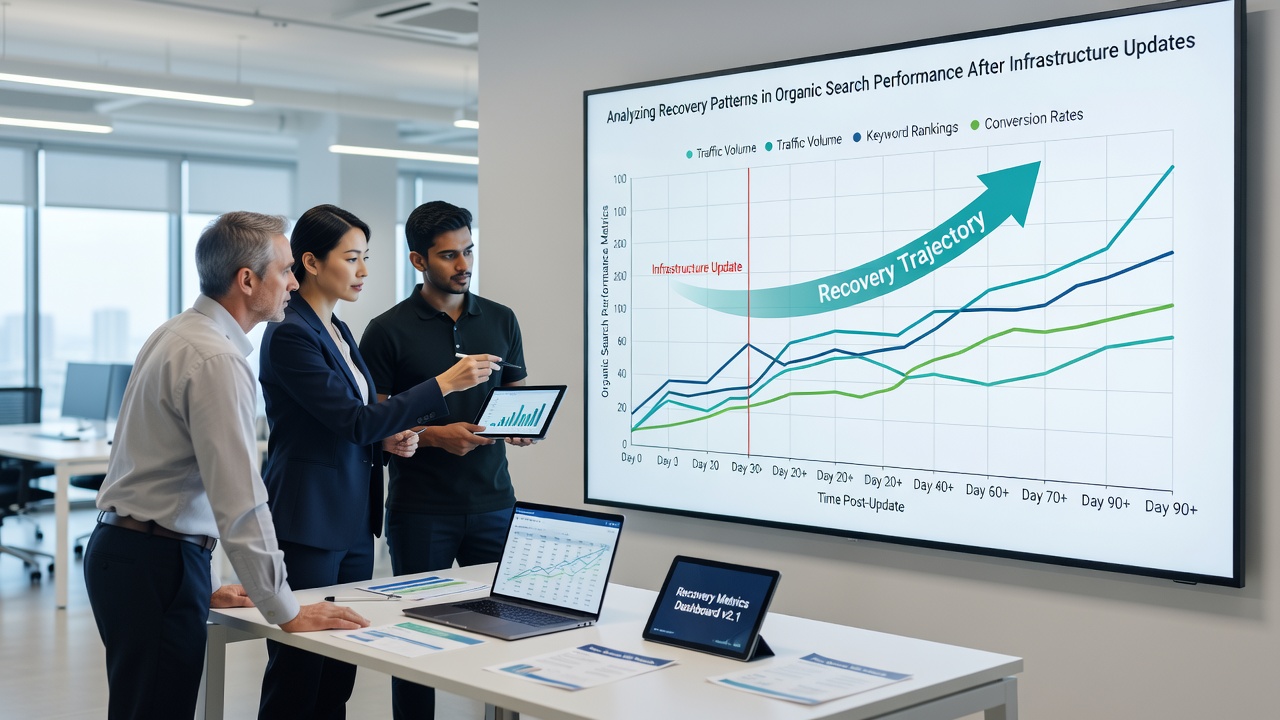
One documented case involved a mid-sized e-commerce platform that completed a full server migration in early 2025, and observers tracked how its organic impressions dropped 45 percent in the first week before climbing steadily once new server responses stabilized and internal linking structures received minor adjustments. Another example from academic research highlighted a news publication that transitioned its content management system while preserving all historical URLs through precise redirect implementation, resulting in indexation recovery within 18 days and ranking restoration across 92 percent of monitored keywords by the end of week five.
Methods for Tracking and Measuring Recovery Progress
Analysts rely on segmented data views within analytics platforms to isolate organic traffic from other channels, and they compare week-over-week changes in key landing pages while monitoring crawl stats to identify any lingering bottlenecks. Regression analysis applied to historical performance data helps distinguish infrastructure-related fluctuations from seasonal or algorithmic influences, and this approach allows teams to establish more accurate recovery benchmarks. External verification through third-party rank tracking services provides additional context because these tools capture position data across multiple search engine result page features including featured snippets and knowledge panels that may reappear at different rates than standard organic listings.
According to documentation available through Google's developer resources, consistent server response times and clear site architecture signals support faster reprocessing after infrastructure events. A separate study published by researchers at a Canadian university examined over 200 sites that underwent migrations between 2023 and 2025, and the results showed that proactive monitoring of log files correlated with 30 percent faster average recovery times across the sample group.
Conclusion
Recovery patterns after infrastructure updates follow predictable phases driven by crawl behavior, indexation mechanics, and external signals, and organizations that maintain detailed pre-update records while addressing technical requirements promptly observe more consistent restoration of organic search performance. Continued observation through September 2026 and beyond will likely refine understanding of how evolving search engine algorithms interact with these technical transitions.